
Haringey · North London
Skimmingin Tottenham.
Skimming can give a room a cleaner, more even surface, but only if the background is ready for it. The real decision is whether the existing wall or new plasterboard is stable enough to take a thin finish without future problems.

- Service
- Skimming
- Neighbourhood
- Tottenham
- Borough
- Haringey
- Next step
- Discuss your project
Your project brief
Decide whether the surface is ready for a thin finish
A skim coat is best used as a finishing layer, not as a cure for a failing background. If the surface is sound, clean and suitably prepared, skimming can improve the room without replacing the whole lining. If not, the better choice may be more preparation first.
That is why a site visit should consider both the visible face and the underlying condition. The aim is to avoid paying for a finish that looks good immediately but does not bond well or perform properly once the room is decorated.
Tottenham and borough-level checks before skimming work
Haringey’s conservation-area page lists several areas where Article 4 Directions apply, but that borough information does not tell you whether your Tottenham property is affected. If skimming forms part of a wider alteration scheme, the exact address should still be checked against the relevant local constraints before you rely on any external or planning assumption.
Design decisions
Check what has been made good before the paint goes on
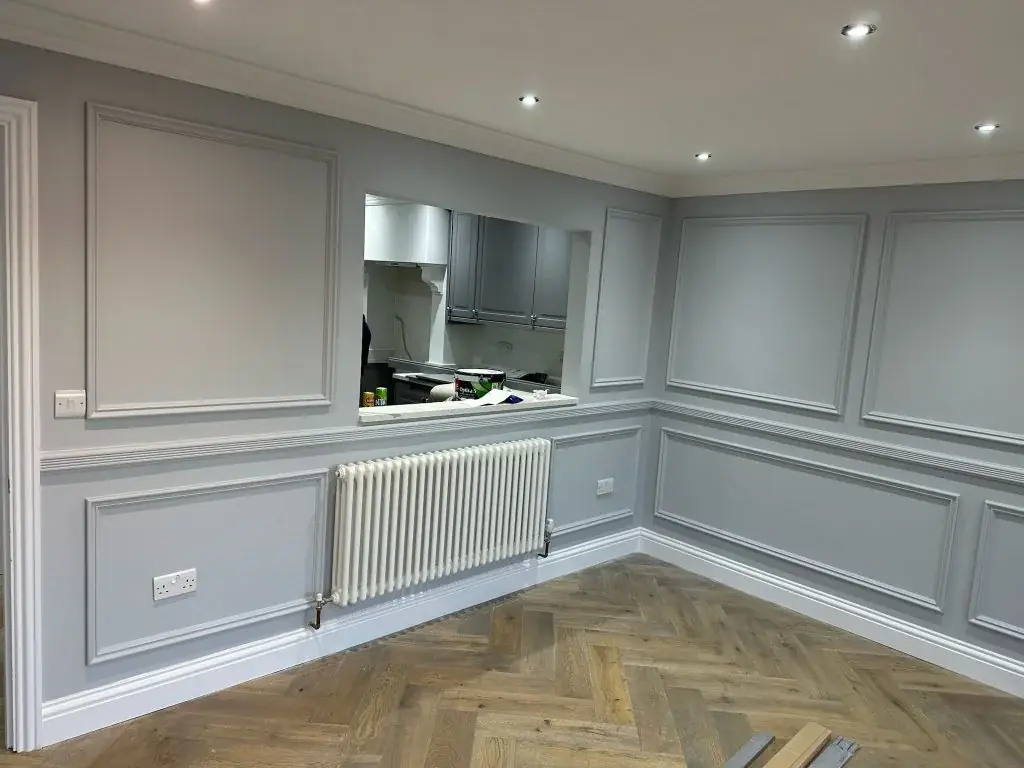
At handover, ask whether the surface has been skimmed, repaired or only lightly touched in at the edges. A homeowner can also check for straight transitions around corners, sockets, door frames and ceiling lines, because those are the places where poor preparation becomes obvious.
It helps to remember that skimming and decorating are separate stages. If a wall still needs drying time, final filling or sanding, that should be made clear before you start planning paint or wallpaper.
Design checks
Four things we confirm before drawing a skim finish.
- 01Confirm the background is sound enough for a thin finish.
- 02Ask what was repaired, what was boarded and what was left in place.
- 03Check edges, corners and junctions before decoration begins.
- 04Separate drying time and finishing prep from the plastering itself.



Is skimming always the fastest way to improve a room?
Not always. If the background is poor, trying to skim it can create more work later. The quicker option is only sensible when the existing surface is already stable and the room needs a finish, not a rescue.
What should I inspect before I paint a skimmed wall?
Look for hairlines, ridges, pinholes and uneven junctions, especially near ceilings, skirting and openings. If anything looks inconsistent, ask whether it is part of normal finishing or needs a further touch-up first.
Can skimming cover all previous defects?
No. It can improve the surface, but it should not be used to hide active movement, damp or loose material. Those issues need dealing with first, otherwise the finish may fail or the defect may return through the coating.
Planning and project guidance
- Development in conservation areas | Haringey Council
- GOV.UK · Planning permission
- GOV.UK · Building regulations approval
- GOV.UK · Party walls and building work
Check the current guidance for your address before relying on a planning route. This guide is not a planning decision or a verified local case study.
Other services in Tottenham








