
Surrey · Epsom · Town service guide
Skimmingin Epsom.
A skim coat gives a room a cleaner finish, but it cannot rescue a poor background. The main decisions are whether the existing surface is stable enough, what preparation it needs, and how the skimming fits around later decoration and joinery.

- Service
- Skimming
- Town / city
- Epsom
- County
- Surrey
- Next step
- Discuss your project
Your project brief
Check the surface before asking for a smooth finish
Skimming is best used where the plaster or plasterboard is already sound but needs refinement. If the wall has movement, moisture or major damage, the right answer may be repair work first, not a thin finishing coat that will simply mirror the underlying problem.
That distinction matters in rooms being refurbished, because you may want a quick visual upgrade without disrupting the whole space. A proper assessment should make clear what can be skimmed, what needs patching, and which defects are too substantial to be covered by finishing alone.
Epsom surface checks before a skim coat is agreed
Epsom addresses may sit within different mapped areas, so check the actual property boundary if the wider project has planning or heritage implications. For skimming itself, though, the decisive factor is the state of the existing surface. Record damp marks, loose plaster, old coatings and any earlier alterations so the finish is matched to the background rather than to the postcode.
Design decisions
Keep preparation and decoration as separate decisions
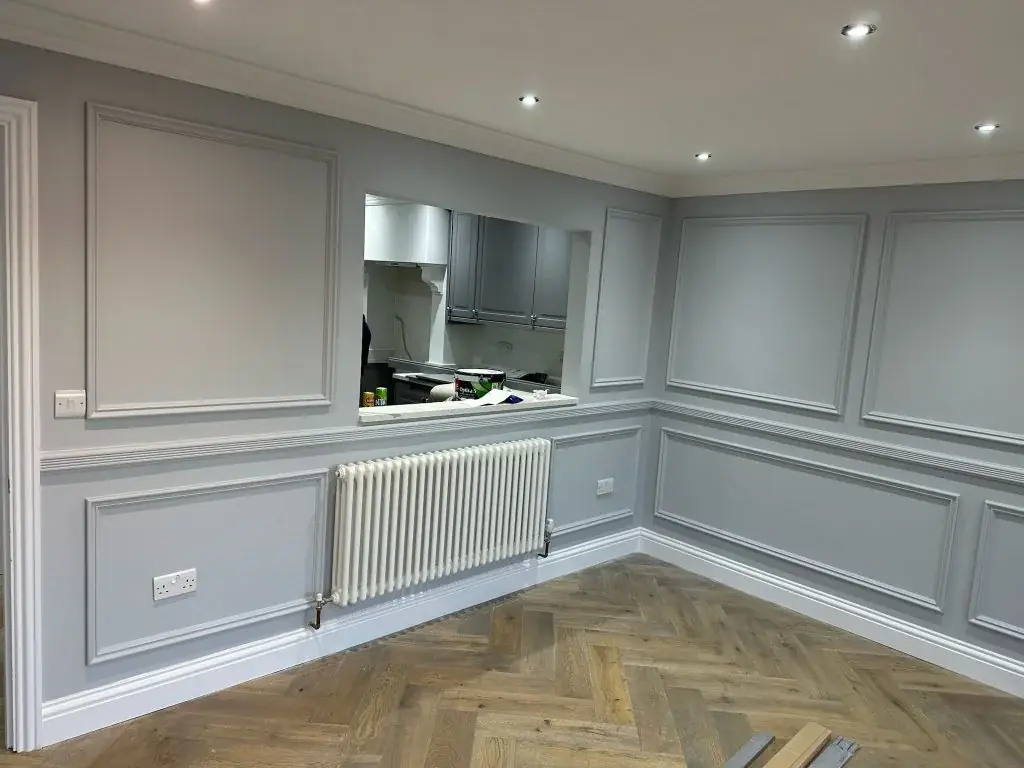
A homeowner can use handover to check that the finish is even, edges are tidy and the room is ready for the next stage. You can also ask whether any old coatings, loose patches or junction repairs were left outside the skim scope so there is no confusion later.
Where ceilings or walls are being brought together after new partitions or opening changes, the more precise the preparation, the better the final result. That is why skimming should be planned alongside the rest of the room rather than treated as an afterthought.
Design checks
Four things we confirm before drawing a skim finish.
- 01Confirm that the wall or ceiling is sound enough for a thin finishing coat.
- 02List any patch repairs, bonding or preparation needed before skimming.
- 03Check that edges, corners and junctions are ready for decoration.
- 04Separate surface finishing from any larger repair work that is not included.



When is skimming better than full replastering?
Skimming is better when the background is sound and only needs a smoother finish. If the surface is loose, badly damaged or still moving, a fuller repair is usually more appropriate before any finish coat goes on.
Should old paint or wallpaper problems be sorted first?
Yes, because poor adhesion can spoil the skim. The background may need cleaning, stripping or patch repair first so the finishing coat bonds properly and does not reveal old defects later.
What should I check at the end of a skim job?
Check for smoothness, tidy edges and consistent coverage, then ask which areas were repaired and which were left outside the scope. That helps you plan painting without confusing finish quality with hidden background issues.
Planning and project guidance
- Epsom and Ewell Borough Council · conservation-area maps, appraisals and Article 4 information
- GOV.UK · Planning permission
- GOV.UK · Building regulations approval
- GOV.UK · Party walls and building work
Check the current guidance for your address before relying on a planning route. This guide is not a planning decision or a verified local case study.
Other services in Epsom








