
Harrow · West London
Decoratingin Harrow.
Decorating is where the room’s final look comes together, but it is only successful if the underlying work is finished and the sequence is right. The best brief explains the surfaces, the finish level and the order in which each step happens.

- Service
- Decorating
- Neighbourhood
- Harrow
- Borough
- Harrow
- Next step
- Discuss your project
Your project brief
Match the finish to the room’s purpose
Decorating choices should reflect how the room is used. A busy family space may need durable finishes and careful detailing around trims, while a quieter room may prioritise a softer visual effect. The point is to choose materials that suit the daily reality of the room, not just a sample card.
Wallpaper, paint and mixed finishes all behave differently. If a feature wall is planned, the brief should say how it relates to the surrounding surfaces and whether the background needs extra preparation so the join lines and patterns remain consistent.
Harrow address checks for decorative changes
Harrow Council says some parts of the borough have conservation-area status, but the council page does not prove that a particular home is in one. That means the exact address must be checked before assuming external decoration is unrestricted. Internal decorating is usually governed by the room’s condition, while listed buildings may need separate consent for changes that affect character.
Design decisions
Sequence the work so the finish is protected
Decorating should come after disruptive building work, not before. If joinery, plastering or service alterations are still due, the fresh finish may be damaged or patched again. A good scope therefore ties the decorating stage to the point when the room is actually ready.
It is also useful to separate final detailing from general coverage. Edges, trims, frames and adjoining surfaces often need more careful work than a broad wall coat, and that effort should be built into the programme rather than treated as a quick add-on.
Design checks
Four things we confirm before drawing decorating work.
- 01Wallcovering preparation and wallpaper hanging where the background is suitable.
- 02Feature walls and coordinated room finishes within the agreed specification.
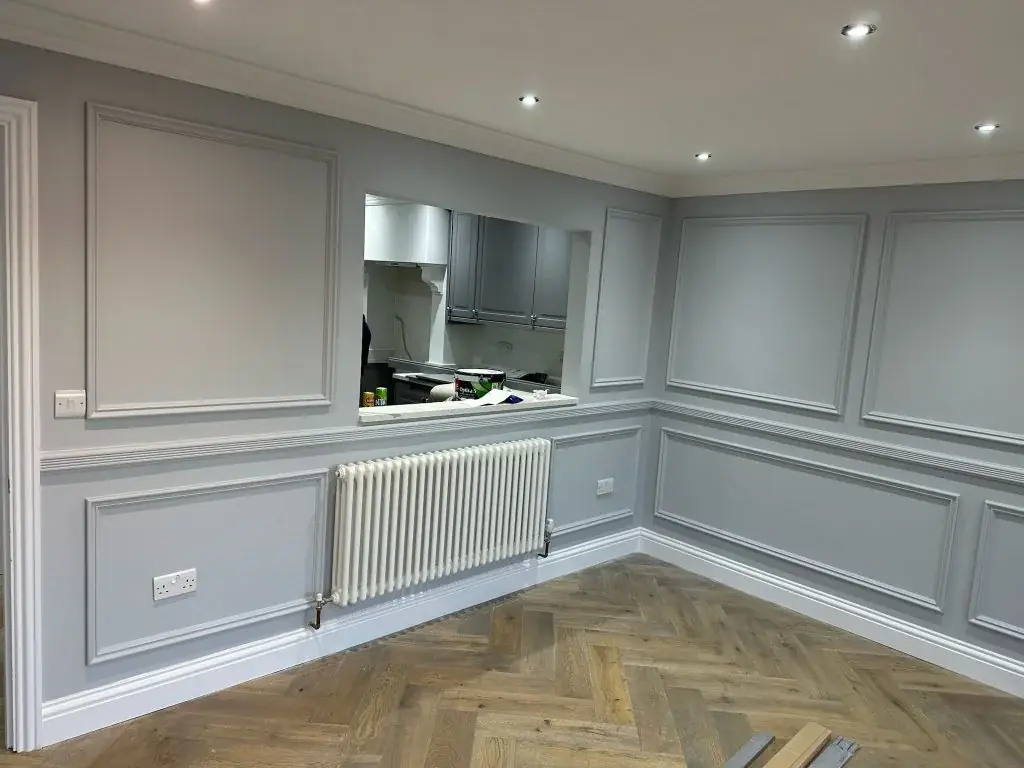
- 03Final detailing around trim, frames and adjoining surfaces.
- 04Decorating after refurbishment once disruptive building work has finished.




What makes decorating different from simple painting?
Decorating can include wallpaper, feature walls, trim detailing and the sequence of finishing work. It is the broader decision about how the room should look and feel, not just the last coat on a wall.
When should decorating happen in a refurbishment?
After the disruptive work is complete and the background is ready. If it starts too early, later trades can damage the finish. The scope should show when the room is clear for final work.
How do I choose a finish that suits the room?
Think about use, wear and how much detail the room needs around edges and joints. A finish that looks good but cannot stand up to daily life will soon need attention again, so durability and upkeep matter as much as style.
Planning and project guidance
- Conservation areas and Article 4 – London Borough of Harrow
- GOV.UK · Planning permission
- GOV.UK · Building regulations approval
- GOV.UK · Party walls and building work
Check the current guidance for your address before relying on a planning route. This guide is not a planning decision or a verified local case study.
Other services in Harrow








